When you reach Walsingham, what can you do by way of an encore?
You might take inspiration from Santiago pilgrims. Around 10 per cent of those who reach St James’s shrine in that city decide to walk on to Finisterre: the end of the Medieval world
The English equivalent is Wells-next-the-Sea, our very own Finisterre.
Wells may only be 6.2 miles further north, but I found that to walk there offered a bucolic, reflective reprise to my 178-mile journey on the London to Walsingham Camino. English ships that carried pilgrims pre-Reformation had to have official permission to do so, and Le Trinity, sailing in and out of Wells, was licensed to carry 40.
It seems very likely that it brought pilgrims to Wells from the Continent, and carried others over the sea from Norfolk, to continue their pilgrimages to Santiago, Rome and Jerusalem by land. Certainly, Walsingham Abbey’s monks and servants came this way on occasion, as the surviving accounts confirm.
These six miles are full of interest, with a cluster of pilgrim points, both past and present, along the way. In the next village, Great Walsingham, 650-year-old St Peter’s has barely altered down the centuries. The three original bells, cast in King’s Lynn between 1330 and 1350, still ring out from the tower.
It has a brightly painted, candy-stripe font cover; poppy head carvings of apostles on pew ends; fantastical beasts on arm rests; and a charming little statue of Our lady of Walsingham on a window sill.
Just beyond the church, a wayside cross stands on a triangle of green, it’s slim, elegant shaft topped by a stone housing with scenes of the crucifixion and what looks like the nativity (it’s badly worn).
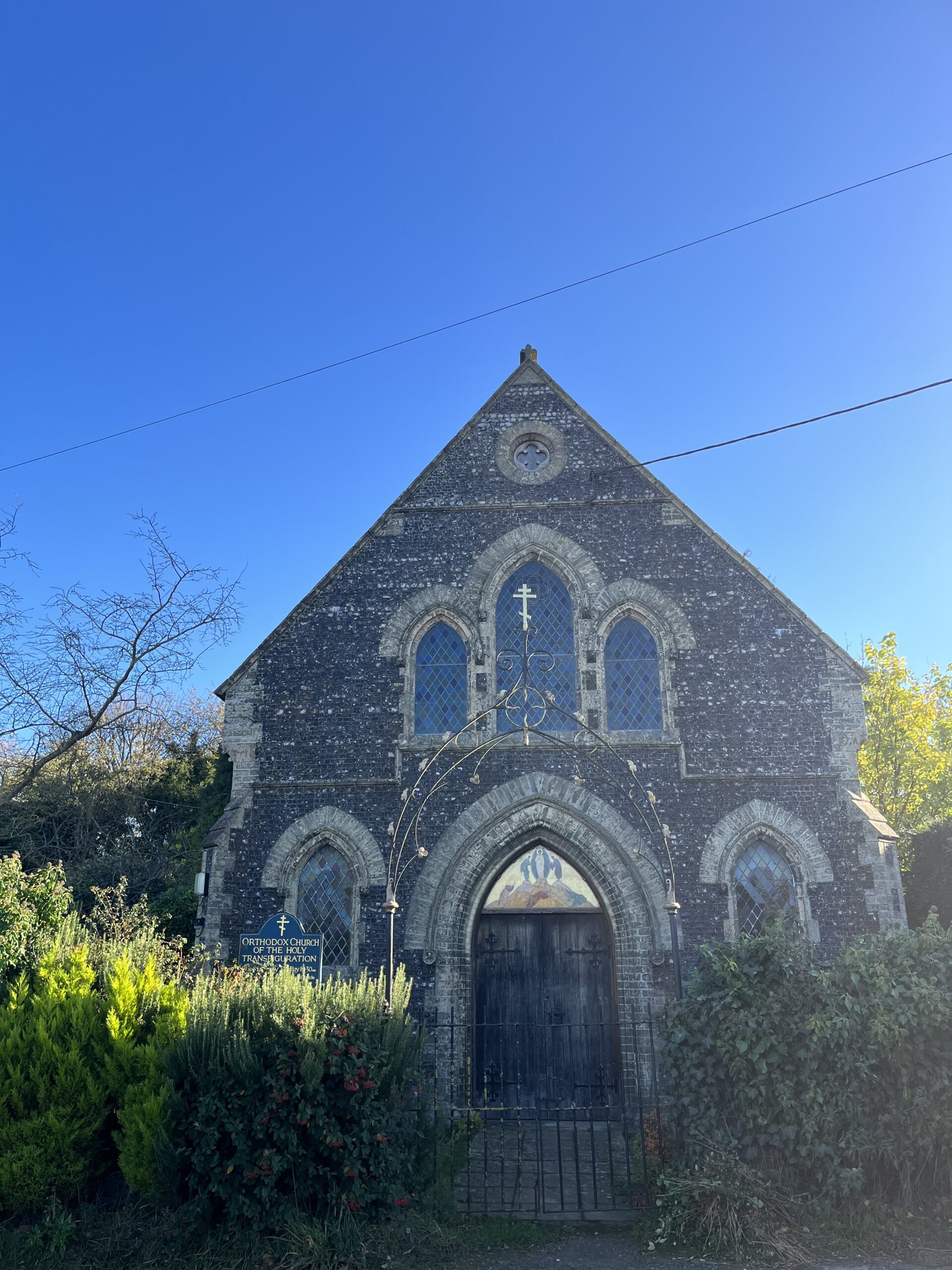
A little further on is another, very surprising church. It looks from the outside like a simple flint chapel, but the name Orthodox Church of the Holy Transfiguration gives an indication that it has changed denominations. Yet that doesn’t prepare you for the remarkable transformation wrought inside.
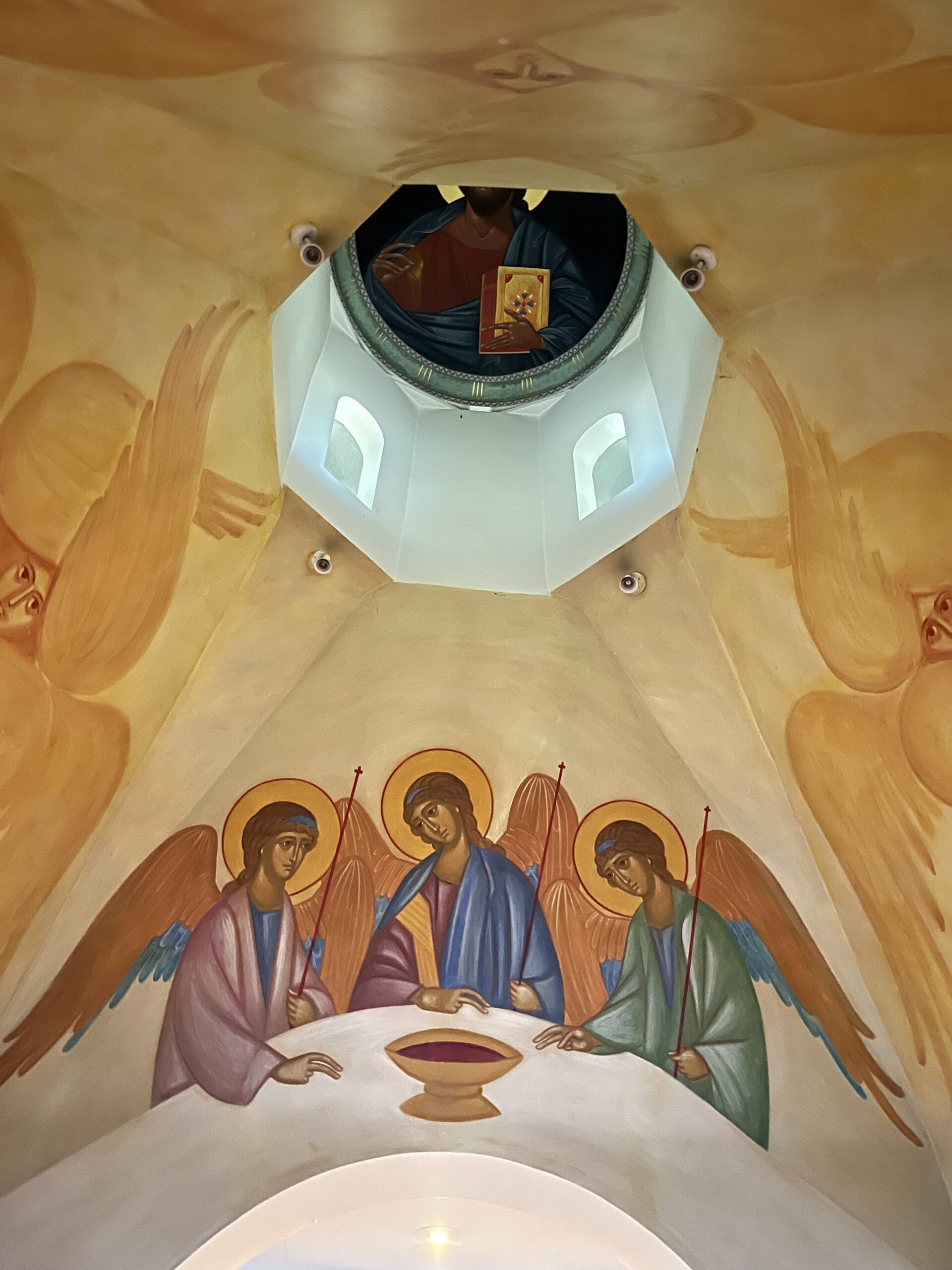
Open the door and you find a fully formed, brightly painted Orthodox church. We peer up into a white dome topped with a lantern into which Mediterranean sunlight streams. This is actually a grand illusion; a trompe d’oile rendering that fools the eye completely.
When we step outside we can’t help looking up to see where that dome appears through the chapel roof. It doesn’t, of course, all is contained within.
The lane continues to Wighton. Half way to that village there was once a wayside chapel, now just an outline in a field just before the wonderfully named Whey Curd Farm.
Leonard Whatmore, in his Highway to Walsingham wrote: ‘It seems not impossible that it was a pilgrim chapel.’ If he is right, it may have served the same purpose as the Slipper Chapel, now the Catholic National Shrine of Our Lady, a mile south of Walsingham Abbey in Houghton St Giles.
There, it is reputed, pilgrims removed their boots to walk the final Holy Mile barefoot. Perhaps pilgrims who came by sea to Wells did the same from here.
Wighton marks the half-way point, and has an excellent pub, The Carpenters, a bustling little place, filling up at noon with those in search of an early lunch. Just past it is another re-purposed church: the Primitive Methodist Chapel is now a Methodist Cultural Centre.

Wighton’s Anglican church of All Saints, high on a rise, announces itself long before you reach the village, the flag of St George fluttering above its tower in the brisk Norfolk breeze.
A more modern wayside cross, the village war memorial, stands behind a seat called The Happy Bench. A sign invites: ‘Sit here if you don’t mind someone stopping by and saying Hi! Nobody needs to feel lonely’.
That prominent tower at All Saints is new, the 700-year-old original lost on a stormy night. In November 1965 it collapsed in an almighty roar that woke the village. It was rebuilt a decade later through the generosity of a Canadian industrialist whose ancestors came from here.
One of the greatest medieval glass painters, John Harrow, was born in Wighton in around 1390. He moved to Norwich, where he was known as John Wighton, and in his workshop produced some of the finest 15th century stained glass. Most was smashed at the Reformation and during the Civil War, but fragments survive here in the top of the nave window traceries.
There are pilgrim waymarks in this church. St James the Great, pilgrim patron, appears in more modern stained glass, and the font bears a shield holding three scallop shells.
From Wighton, the second half of the walk is away from metalled roads, a farm track taking us to Gallow Hill Wood, before a long gentle descent to Wells, the sea glinting before us.
Here, this most Ecumenical of pilgrim journeys takes us to the Catholic church, Our Lady Star of the Sea. We pop into this late 19th century, red-brick Dutch style church beside the green on the Buttlands. It’s a charmingly simple place, with a statue of St Margaret Clitherow, the martyr of York.
It’s just a short walk down narrow streets lined with quirky, independently-owned shops to The Quay, where those medieval pilgrims once ended, or began, their pilgrimages to Walsingham.
…
Full details of the path from Walsingham to Wells, with downloadable maps and step-by-step walking directions, are available online, but only to buyers of the book. Get it from www.trailblazer-gides.com or any physical bookstore or online retailer.